

But first, something else. Last week, a news story about tea caught our attention.
The BBC produced a feature with great enthusiasm about the perfect cup of tea. The English are naturally interested in the perfect cup of tea. It’s a popular topic of conversation throughout the United Kingdom, after all. People there still often drink tea the way we drink coffee. They start their day with it and regularly drink a mug or cup of tea throughout the day, often brewed quite strong and with milk.
And conversations about the perfect cup of tea cover everything from the perfect brand and how long to steep the tea (often a long time) to whether you pour the milk into your cup first—milk in first—or add the tea first.
Salt in your tea?
An American professor, Prof. Michelle Francl, recently spoke about what she considers the perfect cup of tea. You can achieve it by adding salt to your tea. It may sound like a strange suggestion, but it’s an interesting one. The salt blocks the receptors in your taste buds that detect the somewhat bitter flavour tea can have. Adding salt makes the tea taste more pleasant.
Naturally, we’ll put this claim to the test, but more on that later.
The amusing thing about the story was that the US Embassy in the United Kingdom felt compelled to respond.
The embassy declared that the professor’s claim should be taken with a grain of salt. The controversial recipe for the perfect cup of tea could put the special relationship between the US and the UK at risk.
According to the embassy, tea is the elixir of camaraderie, the sacred bond that unites the two nations. And of course, it couldn’t stand by while such an outrageous suggestion to add salt to tea threatened the foundation of the Special Relationship. It added that it would never be US policy to make tea this way.
The story ended with the reassuring words that the embassy would continue to make tea as it should be made: in the microwave. That was meant to be a little ironic, as it referred to another “diplomatic row” between the nations, when an American woman demonstrated on TikTok that you can make tea in the microwave. Many a Brit (and we too) shudders at the thought....
This story once again shows just how important British tea culture is—and how, however trivial the subject may seem, it can spark debate right up to the highest diplomatic levels.
Back to the subject: salt in your tea. Prof. Francl had good reason to put the perfect cup of tea on the agenda. According to her, tea is often prepared in an appalling way. For example, with lukewarm tap water. (Yuck.)
She also recommends preheating teacups and teapots, because a high temperature helps extract caffeine from the tea leaves. It also helps the antioxidants—which are an important component of tea’s flavour—dissolve better. The latter is a matter of taste, though.
As for the milk, the professor says it should only be added once the tea is in your cup, to prevent it from curdling, and the milk should be warm too.
Loose-leaf tea is preferable, or otherwise teabags with enough room for the leaves to move around. Prof. Francl thinks it’s important to steep the tea for a short time, while giving the teabag a good bob up and down. A short steeping time helps limit the sour tannins in your tea.
Putting it to the test
We did a little test. A pinch of salt in tea does indeed make it less bitter. But since bitter tea isn’t really our cup of tea, it took some searching to find a tea bitter enough to test it properly. Our own loose-leaf tea didn’t fit the bill.
So, we don’t think salt is necessary for the perfect cup of tea. Besides, we already get enough salt in our daily diet, so it’s not a good idea from a health perspective either.
(And besides, if you add milk to your tea, it already masks or softens any bitterness. That makes salt completely unnecessary. Perhaps salt also acts as a flavour enhancer for the milk in tea?)
So much for Professor Francl.
Here’s how to make the tastiest tea
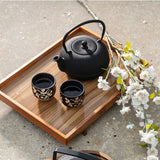
There’s no accounting for taste, of course. So if you already enjoy the way you make your tea and have a good method, just keep doing what you’re doing. Want to find out more or perfect your perfect cup of tea? Here are a few tips.
The basics for your perfect cup of tea
First things first: we’re talking about tea (Camellia sinensis) here, not rooibos or herbal and fruit blends. At the end of this blog, we’ll also share general brewing guidelines for those.
1. Use loose-leaf tea.
This isn’t a hard-and-fast rule. Teabags are fine too. But there are two good reasons to use loose-leaf tea :
- Loose tea leaves can be given room to move. With loose-leaf tea, you can choose whether to use a small or large filter. You can also let the leaves steep freely in your teapot and strain them out afterwards.
- There are many more varieties of loose-leaf tea than there are of teabags. That means you can try different kinds and/or look for the tea you like best.
2. Follow the instructions on the packaging
For each tea, we recommend following the brewing instructions on our website and on the packaging. That’s a good place to start. You can always experiment after that, preferably by increasing or reducing the amount of tea.
3. Use the right temperature
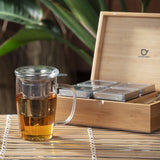
The temperature of the tea water can vary. But some types of tea, particularly green tea, become bitter at high temperatures. As a rule of thumb, green tea should be brewed at a maximum of 80 degrees. Some varieties have a lower maximum temperature, though.
A thermometer or a temperature-controlled kettle can be useful. You can also let your boiling water cool for a few minutes before adding the tea.
4. The amount of tea
You can safely experiment with the amount of tea. If it doesn’t taste strong enough, simply add a few more leaves.
5. Don’t steep for too long
Once you’ve put your tea leaves in the water, let the tea steep gently. This allows the aromas and other compounds in the tea leaves to infuse gradually into the water. If you steep the tea for too long, it can become astringent. It’s best not to exceed the recommended steeping time on the packaging.
General guidelines
Use 12 g per litre, or about one teaspoon per cup. These guidelines will nearly always give you a good result. But feel free to experiment!
1. Black tea: 90–100 °C, 2 minutes
2. Green tea: maximum 80 °C, 1.5–2 minutes
3. White tea: 80–100 °C, 1–2 minutes
4. Yellow tea: maximum 80 °C, 2–3 minutes
5. Oolong tea: 80–100 °C, 2 minutes
6. Post-fermented tea (Pu Erh): 100 °C, 1–2 minutes
7. Rooibos: 100 °C, 5 minutes
8. Herbal and fruit infusions: 100 °C, 8–10 minutes
Soft water—that is, low-mineral water
Soft water produces the best results for almost all types of tea. Dutch tap water varies, but often contains more lime than is ideal for making tea. The advantage of soft, or lime-free, water is that the flavour compounds in the tea leaves dissolve better. Your tea will have more flavour.
In The Book of Tea by the Chinese writer and tea master Lu Yu (733–804), “The Classic of Tea” (Cha Jing or Ch’a Ching), it is recommended that you use water from the place where the tea bush grows. And it turns out that this water is indeed low in minerals.
If you want to use soft water, there are roughly three options: you can use low-mineral spring water, have a water softener installed in your home, or use a filter jug that removes lime from your water.